Recently, my wife and I watched again Peter Jackson‘s films of The Lord of the Rings, J. R. R. Tolkien‘s masterwork. Now, we are watching the films with the director’s, producers’, and writers’ commentaries. The question that immediately arises when one watches a movie based on a book that one loves is whether the movie does the novel justice. Does the movie tell the same story as the novel?
We have enjoyed the story of The Lord of the Rings in three media: Tolkien’s novel, Jackson’s film, and the BBC’s radio production. I have read, viewed, and listened to each of these many times. Is the story the same in each medium?
The answer is "No," if by "the same," one means that the movie and the novel are identical in each detail. Given the differences between a film and a book, it is impossible that the two be identical.
The answer is "Yes," if by the "the same," one means that the movie and the novel tell the "same story," however different the two may be in detail. For The Lord of the Rings, my judgment is that Peter Jackson does tell the same story as does Tolkien. For that matter, the BBC’s radio production also tells the same story.
Consider this possibility: the "real" Story lies behind any particular telling of the story in any medium. While we can consider Tolkien’s novel to be the canonical (authoritative) version of the Story of the destruction of the One Ring, the other versions can still tell the Story, although different in detail from the canonical version.
The BBC radio production is very close textually to the novel. (Ian Holm plays Frodo in this version, and, of course, he plays Bilbo in Jackson’s films.) But the radio version omits the Old Forest, Bombadil, and the Barrow Downs just as does Jackson’s film. Like most readers of the novel, my wife and I both delight in Tom Bombadil and Goldberry; yet I understand why someone telling the Story in a different medium would omit them.)
An analogy for the relationship of Jackson’s films to the novel: we can see the films (and the radio production) as remixes of the novel, just as musicians remix songs and albums. Actually, musicians may release a song in versions of different lengths; in such a case, do we ask which version is the "real" song? Really, we decide which version we prefer. Realistically, isn’t that what people do with novels and movies based on them?
Here’s a last question, which I only mention: how much can a version (or remix) of a story change it without making it a different story? It’s a question that I and the students of a course in the fantastic in literature and film discussed without arriving at any kind of definite answer. The answer is surely up to the individual.
Archives for December 2007
Which Is the Real Story?
Honors for Three English Majors
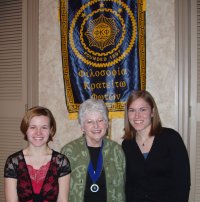
At Zeno’s Steak House at 5:30 p.m., Thursday, December 6 , three English BA students were inducted into Phi Kappa Phi, a national honor society.
Two of the students, Kathryn Knocke and Laura Ward, are pictured here with Elizabeth Cummins, professor emeritus of English and Technical Communication. Dr. Cummins is the president of the local chapter of Phi Kappa Phi. The third student inducted is Andrew Moss, who has been studying in London this fall (after studying in Italy this past summer). These three students are among approximately 30,000 students, faculty, professional staff and alumni to be initiated into Phi Kappa Phi each year.
Phi Kappa Phi was founded in 1897 at the University of Maine. It is the nation’s oldest, largest and most selective all-discipline honor society. The Society has chapters on nearly 300 campuses in the United States, Puerto Rico and the Philippines. Membership in Phi Kappa Phi is by invitation and requires nomination and approval by a chapter. Only the top 10 percent of seniors and 7.5 percent of juniors, having at least seventy-two semester hours, are eligible for membership. Graduate students in the top 10 percent of the number of candidates for graduate degrees may also qualify, as do faculty, professional staff and alumni who have achieved scholarly distinction.
The English and Technical Communication Department congratulates these three students on receiving this honor. You make us proud!
It Takes a Team to Pedal Fast
This afternoon, Missouri University of Science & Technology’s chancellor, John F. Carney III, delivered his fifth semi-annual State of the University speech. A high point was Tom Shipley‘s brief documentary on Missouri S&T’s entry in last summer’s human-powered vehicle contest. The vehicle was designed and built by UMR — pardon me — Missouri S&T’s Human-Powered Vehicle Team, a part of the campus’s Student Design and Experiential Learning Center. Shipley’s film is tight and clean and the source of the title of this entry: it takes a team and a lot of effort for someone to pedal a little over 59 mph.
Yes, I jumped the gun on the name-change from University of Missouri – Rolla to Missouri University of Science & Technology. But that particular gun is being jumped more and more often. Why not me?
Wait a minute! Why am I writing about student design teams? I’m chair of English and Technical Communication, not an engineer.
- First, I admire the student design teams, having known students in them in my own classes.
- Second, our department is a vital part of the campus and its endeavors, as Chancellor Carney noted early in his state of the university talk. The chancellor reminded the audience forcefully that, while he would talk mostly about scientific and technological matters, he did not want to overlook the humanities, the social sciences, or the business program.
- Third, there are numerous ways, many yet to be discovered, in which the scholars, teachers and students of our department can relate to the campus’s major thrust. One important way is to pursue our own research and teaching interests with energy and imagination. Our efforts do contribute to the overall accomplishments of the campus. Another way is participation of our students and faculty in projects of other departments and organizations.
Enough with metaphor and analogy! The university is not a bicycle in an aerodynamic cocoon, with its power-source, a student, concealed inside: the university is a complex enterprise, dependent on everyone, everything, every place that make it up. Ending his talk, the chancellor called on the university to focus on our world’s needs for energy and environmental renewal. Those of us who work with words and images can contribute our knowledge, skills, wit, and wisdom to that project.