Main

April 15, 2008

Steel Needles and WiFi

It's been way too long since I posted here. I hope to post more frequently.

Why haven't I posted for several weeks? One reason: I've been ill for three weeks, culminating in five days in the hospital. (If you go to the site, my room was the middle one on the second floor: just above the apostrophe in "it's." I had a very persistent pneumonia.

I also had intravenous fluids, including lots of antibiotics. Frequent breathing treatments accompanied the usual check of my "vitals": blood pressure, temperature, oxygen saturation in my blood, pulse. I'm pleased to report that my pulmonary function test (not an easy procedure) showed my capacity to be "normal" for a man of my age, height, and weight.

Anyone who's spent days and nights in a hospital knows that one's mortality is foregrounded, even though one's illness isn't critical. I had plenty of time to reflect on diet and exercise and make decisions about refinements and changes. Other patients' coughs and moans punctuate one's sleep; the med evac helicopter tends to come and go at intervals throughout the night.

I received very good care from the nursing staff, my doctors, and the technicians in various laboratories. The meals were against the stereotype of how awful hospital food is; the food was plentiful and reasonable good, with the exception of some unfortunate vegetables.

Decades ago, I worked in two hospitals (Mt Zion Medical Center in San Francisco and Newman Memorial Hospital in Emporia, Kansas) as an orderly in Central Supply. That lead to two or three interesting conversations with nurses, including one of the younger nurses, who was astounded that we used steel needles that I cleaned, sharpened, packaged, and sterilized. "You're showing your age!" she said. But I don't need to talk about steel needles to show my age.

Five days essentially away from computers and news was a real vacation. Actually, the hospital is very computerized. Everyone but housekeeping and the doctors came into my room with a computer. But I didn't have to use them. The hospital's Web site says it won "Health Care's Most Wired" for 2007. I believe that. There is even WiFi for patients, but after one very tiring session with my laptop, I sent it home. (As you can tell, now that I'm home, it's hard to stay away from the computer, but it does tire me, so that's it for now.)

March 18, 2008

Nearly a month later . . .

I hadn't realized how much time had passed since the last entry here. Here's a brief entry:

Dr. Ed Malone, assistant professor of English and Technical Communication, and Director of Technical Communication, has begun writing a quarterly column on the history of technical communication. His column appears in the IEEE Professional Communication Newsletter. The latest column is about Dorothy Dahle, a pioneering woman in the field. The column touches on the difficulties a woman faced entering the field in the 1950s. It's well worth reading.

The next entry will show up here much sooner than the four weeks between this one and the previous.

February 21, 2008

Education in Winter

We're experiencing our third winter storm of the year — with sleet mostly, but also a little snow. The sleet verges on freezing rain. What happens at Missouri University of Science & Technology when we have icy, slushy streets and sidewalks, with more sleet falling as I type?

Many faculty and some students live where it's dangerous or impossible to drive to campus. Walking, too, is hazardous when everything is coated with ice. It's fairly quiet in the department this morning, although I've seen four faculty members, and talked with three or four students. The department's administrative assistant, Linda Sands, lives several miles out in the country amid hills that, when the roady is iced over, make driving very hazardous. She's not here today.

The quiet and relatively few people are somewhat disconcerting. It's almost lonely.

I drove to campus, as I usually do, although I live within a 15 minute walk. I have walked to campus in worse weather than this, but . . . perhaps I have more (or less) sense.

Continue reading "Education in Winter" »

January 23, 2008

Who Wrote the First Computer User Manual?

To learn who wrote the first user manual for computers, go to Ed Malone's column in the IEEE/PCS online newsletter.

Dr. Malone has agreed to write a quarterly column for the newsletter of the IEEE Professional Communication Society. As this first column shows, Ed has been doing extensive research in the history of technical communication and is able to present the results effectively.

January 22, 2008

Where Did Your Steak Come From?

People are becoming more concerned about the origins of their foods, including beef. In his PhD dissertation, David Wright (assistant professor of English and Technical Communication) studied the efforts of the US Department of Agriculture to use RFID devices implanted in cattle to trace them from origin to use. The cattle industry was not receptive to the proposal to implant Radio Frequency Identification devices in their stock.

On Friday, January 18, Dr. Wright was interviewed by Wayne Huebner, host of radio station KMST's TechnoFiles program. You may listen to the full interview in MP3 format here.

January 12, 2008

Just a Couple Days Before Classes Start

The spring 2008 semester for Missouri University of Science & Technology starts on Monday, January 14. Here it is, Saturday, January 12, and I'm putting together course materials. (I suspect I'm not alone in that!)

This is the university's first semester as Missouri S&T, rather than the University of Missouri - Rolla. We're all making the transition in how we refer to the campus, with some uncertainty whether it is "MST," "MS&T," or "Missouri S&T." Officially, "mst" is reserved for our email and Internet domain, not for print or speech. However, it's only three syllables versus four or seven in the other possibilities.

"S&T" is a good designation but a little too obscure right now. The Rolla Daily News uses it, so maybe it will spread.

I did quite a bit of class preparation back in December but still have plenty to do. I'm teaching Creative Writing for the first time in several years and using Blackboard for the first time for that class.

For a department chair, preparing for a new semester means much more than writing up (or revising) the course syllabus. It also means making sure all the courses taught by the department have teachers assigned to them, that everyone has appropriate office space, that the courses have sufficient enrollment.

In fact, I've been constructing the class schedule for the fall 2008 semester.

My colleagues in the department are doing their preparations (or have already completed them); some of my students have already visited Blackboard. Unfortunately, there won't be much there until sometime late today or tomorrow.

Enrollment for this spring semester is slightly higher than for last spring. This weekend, the population of Rolla will expand by several thousand. The campus has felt very empty recently; that changes soon.

December 11, 2007

Honors for Three English Majors

phi_kappa_phi.jpg
At Zeno's Steak House at 5:30 p.m., Thursday, December 6 , three English BA students were inducted into Phi Kappa Phi, a national honor society.

Two of the students, Kathryn Knocke and Laura Ward, are pictured here with Elizabeth Cummins, professor emeritus of English and Technical Communication. Dr. Cummins is the president of the local chapter of Phi Kappa Phi. The third student inducted is Andrew Moss, who has been studying in London this fall (after studying in Italy this past summer). These three students are among approximately 30,000 students, faculty, professional staff and alumni to be initiated into Phi Kappa Phi each year.

Phi Kappa Phi was founded in 1897 at the University of Maine. It is the nation’s oldest, largest and most selective all-discipline honor society. The Society has chapters on nearly 300 campuses in the United States, Puerto Rico and the Philippines. Membership in Phi Kappa Phi is by invitation and requires nomination and approval by a chapter. Only the top 10 percent of seniors and 7.5 percent of juniors, having at least seventy-two semester hours, are eligible for membership. Graduate students in the top 10 percent of the number of candidates for graduate degrees may also qualify, as do faculty, professional staff and alumni who have achieved scholarly distinction.

The English and Technical Communication Department congratulates these three students on receiving this honor. You make us proud!

December 03, 2007

It Takes a Team to Pedal Fast

This afternoon, Missouri University of Science & Technology's chancellor, John F. Carney III, delivered his fifth semi-annual State of the University speech. A high point was Tom Shipley's brief documentary on Missouri S&T's entry in last summer's human-powered vehicle contest. The vehicle was designed and built by UMR — pardon me — Missouri S&T's Human-Powered Vehicle Team, a part of the campus's Student Design and Experiential Learning Center. Shipley's film is tight and clean and the source of the title of this entry: it takes a team and a lot of effort for someone to pedal a little over 59 mph.


Yes, I jumped the gun on the name-change from University of Missouri - Rolla to Missouri University of Science & Technology. But that particular gun is being jumped more and more often. Why not me?

Wait a minute! Why am I writing about student design teams? I'm chair of English and Technical Communication, not an engineer.

  • First, I admire the student design teams, having known students in them in my own classes.
  • Second, our department is a vital part of the campus and its endeavors, as Chancellor Carney noted early in his state of the university talk. The chancellor reminded the audience forcefully that, while he would talk mostly about scientific and technological matters, he did not want to overlook the humanities, the social sciences, or the business program.
  • Third, there are numerous ways, many yet to be discovered, in which the scholars, teachers and students of our department can relate to the campus's major thrust. One important way is to pursue our own research and teaching interests with energy and imagination. Our efforts do contribute to the overall accomplishments of the campus. Another way is participation of our students and faculty in projects of other departments and organizations.

Enough with metaphor and analogy! The university is not a bicycle in an aerodynamic cocoon, with its power-source, a student, concealed inside: the university is a complex enterprise, dependent on everyone, everything, every place that make it up. Ending his talk, the chancellor called on the university to focus on our world's needs for energy and environmental renewal. Those of us who work with words and images can contribute our knowledge, skills, wit, and wisdom to that project.

November 18, 2007

Taking a Break

Thanksgiving break started officially this weekend, a landmark eagerly awaited. For some it started earlier, sometime last week. Friday, the campus population was down quite a bit -- the boisterous voices, the standing, sitting, slouched students crowded in the hall, waiting for class . . .

Yesterday morning (Saturday), I walked downtown to get my hair cut, prepared to go for a coffee if the barbershop were full. It wasn't. Very few cars were parked along Pine Street; there were hardly any pedestrians. A cool sunny November morning and nobody around. Several thousand students gone, the town grows quiet. Of course, faculty leave as well as students. I'm one of those grinds who doesn't leave but sticks around to try to catch up.

The title of this entry, "Taking a Break," might refer to the fact it's been three weeks since I posted here. I hadn't realized so much time had passed -- not a deliberate break, either, just busyness and distraction.

Whatever you do over this week, I hope it's fun and relaxing.

October 21, 2007

A Blue Violin: Homecoming

UMR's homecoming ends today, October 21. The weather has been cool, clear, and windy. Nearly perfect, depending on what one thinks of the wind.

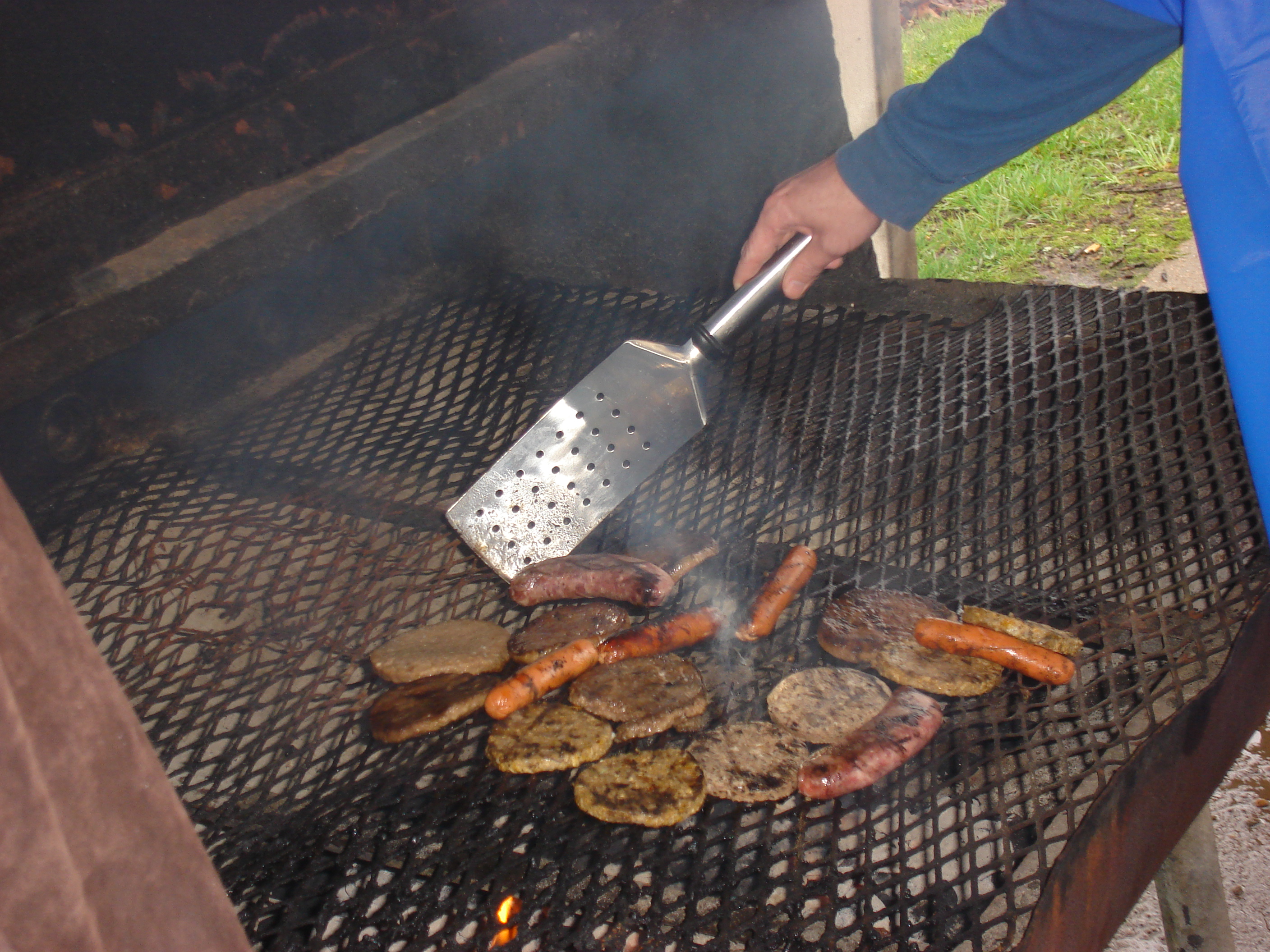
My experience of the wind and of homecoming came on Friday afternoon at the departmental open house. Among the homecoming events were the departmental open house on the patio outside the Havener Center. Under a green and white tent, at the curve of University Drive, a beer and soda garden offered burgers, brats, barbecue, beers, soda — all the necessities for such a pleasant afternoon.

With the green grass of the Havener lawn, the crowds moving from place to place, the scene reminded me of William Langland's "fair field full of folk": an apt description of the scene Friday afternoon.

Not having anticipated a blog entry on this event, I didn't take my camera or notes, so I'm reaching back a day and a half. My primary impression is wind and sun and glimpses of a woman with a blue violin.

Dr. Ed Malone and I carted the department's display over to the patio along the front of the Havener Center. The departmental displays vary some, but basically, it is a panel about 3' x 6' that folds so there's a large central panel with two smaller panels on each side. The side panels fold to provide stability and depth to the display. The main ingredient in the departmental open houses was the wind. The displays would not stay on the tables provided; some departments put theirs on the ground in front of the tables; some, like us, packed up their display. We did have some books authored by faculty members, copies of last spring's departmental newsletter, and some brochures. These didn't blow away (mostly).

A bluegrass band played around the curve of the Havener from us. I couldn't see them well because of the pillars, but I did see a woman playing a blue violin.

The best part for me was a long conversation with one of our English alumna. She and her husband stopped at the table, and we caught up on a lot of things, mostly what's happening with the department and with some of the older and retired faculty. Another alumnus, a friend of the couple I was speaking with, walked up. He got his B.S. here in 1967, the year I arrived. He and I have to be among the few people who remember John Brewer, who taught speech and who, we agreed, was the last gentleman.

There really wasn't a lot of traffic at the department displays, but my time was well-spent. Despite my somewhat peripheral relation to homecoming, spending Friday afternoon in the wind and sun, talking with a former student, was good.

October 13, 2007

An MS Thesis on Arthurian Literature

Question: When was the first Master's degree in literature awarded at the University of Missouri Rolla (UMR)?

Question: What was the topic of the thesis?

Answer(s): First, revise the first question to " When was the first Master's degree in literature awarded at the Missouri School of Mines (MSM)?" As you may know, this campus was known as the Missouri School of Mines from its founding in 1870 until it became the University of Missouri-Rolla in 1964. As part of the University of Missouri system, this campus has a long, proud history of educating engineers, scientists, and, in the last 40+ years, humanists and social scientists.

Second, notice that I didn't specify whether the degree was a Master of Science or a Master of Arts. (One would expect the latter with a literary topic.)

Third, the answers to both questions from Elizabeth Cummins:

In 1927, the Master of Science degree was awarded to Nadine Matlock Sease. Her thesis (which is in the UMR library) was "The Origin and Development of the Arthurian Story in English Literature in the Nineteenth Century." I believe it was the first M.S. degree awarded to a woman (maybe even to anybody!) in the humanities/social sciences. I think she was from St. James and may have taught English at MSM.

The thesis is in the Curtis Laws Wilson Library at UMR.

My thanks to Elizabeth Cummins, professor emeritus of English and Technical Communication, for bringing this piece of history to our attention. I don't know anything more about Ms. Sease; however, I do hope to learn more. If you know more about this bit of UMR history, please share it with me. I will post it here and give credit to the source.

September 23, 2007

New and Better Computing

The English Department began developing ideas for a writing center in the 1990s. Dr. Elizabeth Cummins and Dr. Larry Vonalt were important forces behind the department's request for a Center for Writing Technologies. Their project was finally realized in the establishment of the Writing Across the Curriculum Program, which includes the Dr. Beverley Moeller Writing Studio and the Center for Writing Technologies.

writing_center-1.jpg

A pod of new computers in the Writing Center
Photo taken with the webcam on one of the new computers

While administratively separate from the Department of English and Technical Communication, the Writing Center and the department are close allies, especially concerning the Center for Writing Technologies (usually called "The Writing Center").

This summer, the department arrived at a plan to share licensing fees for new and upgraded hardware and software. I'm sure you are aware of the rate of change of software and hardware. To best serve our students, especially majors in Technical Communication, we need the best equipment and software available. The Writing Center was updated this August.

The updates this summer make the Writing Center UMR's premier authoring lab. It was designed by a committee of faculty and staff from various departments: Todd Kreuger (Information Technology [IT]), Connie Melone (IT), Jim Turner (IT), John Sequin (Library), Kate Drowne (English and Technical Communication), Richard Hall (Information Science & Technology), and Ed Malone (English and Technical Communication). The new equipment and software were paid for by IT, Center for Technology Enhanced Learning, and English and Technical Communication

In the future, this lab will accommodate such courses as Web-Based Communication and Multimedia Development and Design. In TCH COM classes this semester, students are authoring help systems with RoboHelp and creating books with FrameMaker; next semester, they will be conducting usability tests and creating tutorials with Camtasia.

The lab has extended hours this semester (6-9 M-Th and 12-9 on Sundays) and hired a lab monitor to help patrons.

The new and updated software is available in two other locations on campus. In Computer Science 207, all of the Adobe programs — except RoboHelp — are available 24/7. One of the machines in the library also has all of the Adobe programs — including RoboHelp — so that a student can complete assignments on Friday evenings or
Saturdays. The library also purchased a collection of Adobe classroom-in-a-book tutorials for the specific versions of Adobe programs we have and other tutorials for RoboHelp, Camtasia, and so on.

Continue reading "New and Better Computing" »

September 04, 2007

New Roles for Two Faculty Members

Beginning with the fall 2007 semester, Dr. Kris Swenson and Dr. Ed Malone, will each add a new role to their responsibilities in the Department of English and Technical Communication. As the number of students increases, managing the courses they take becomes more complex. The department itself is changing in response to changes in the student body and to changes in the campus. In addition, our BS and MS degrees in Technical Communication are not quite two years old: these programs need attention and effort to develop most effectively.

As Coordinator of Writing Courses, Dr. Swenson will oversee the Department's English 20 (Exposition and Argumentation) and English 60 (Writing and Research). English 20 is "freshman comp," an important course taken by almost all incoming freshman. Her duties also include working with the faculty teaching these courses and coordinating policies and practices for the courses.
kris.jpg
Dr. Kris Swenson


As Director of Technical Communication, Dr. Malone will work extensively with the graduate students on issues ranging from admission to keeping statistics on their test scores. Dr. Malone will also aid in recruiting both undergraduate and graduate students for the technical communication programs.ed.jpeg

Dr. Ed Malone


For my part as chair, I welcome these new roles for Dr. Swenson and Dr. Malone. The department will function more effectively because of their contributions. Thanks are due the Provost, Dr. W. Kent Wray, and the Chancellor, Dr. Jack Carney, for making these new roles possible.

September 02, 2007

Celebration

The fall semester has well and truly begun. The first wave of student questions and dilemmas is over. (That first wave ranges from trying to find a classroom to trying to get into a class to finding an instructor.) For all that the university has over 1200 new freshman, there were fewer problems of this kind this fall.

Now that enrollment and class schedules have pretty well settled down, faculty, students, and staff can take stock and focus fully on the tasks of teaching, learning, and facilitating. The Department of English and Technical Communication sponsored a "Welcome Back" reception on Tuesday, August 28. Students and faculty from several departments mingled and ate goodies. erin_cake.jpg In this photo, Erin Cotita, English major and department student assistant, prepares to cut the cake for serving.

The reception ran from 1:00 to 2:30; those attending did more than eat, as shown in this photo of students (Irangi, Li and Tommy) talking with Professor Emeritus, Nick Knight, and parent, Glenn Cotita. reception-1.jpeg

Together with the break in the heat we're experiencing (highs of 85 F are much more pleasant than highs of 105 F) and the relatively smooth start of a new semester, this reception put, so to speak, the icing on the cake. (Or the dip on the crudités. if you will.)

August 12, 2007

Gold & Green Balloons

This week temperatures are to be well over one hundred. Despite the heat, a number of new freshmen and family members were on the UMR campus this morning. Today (Saturday, August 11) is the last PRO day for the 2007/2008 academic year. PRO is an acronym for "Preview, Registration, and Orientation." Students who attend a PRO session experience a variety of activities, including placement testing and registration for fall courses.

I went to PRO this morning to help a new student in English Education register for her fall courses. The opening activity occurred in St Pat's Ballroom A in the Havener Center. At a couple of tables in the hall, PRO staff and student leaders answered questions and directed students and their parents into the opening activity. There were outbursts of laughter from the ballroom, so the activity must've been amusing as well as informative.

PRO events are cheerful — the student PRO leaders wear green shirts with gold trim; gold and green balloons float from the tables and, out on the campus, from the directional signs placed to guide students and their families on their treks across campus. ("Treks" because even at 10:00 AM today, it was very hot, with an intense sun and no breeze.) The student and I put together a good schedule for her to start her college career.

Each department has an advisor designated to advise PRO students. I did this for a number of years and enjoyed it. The PRO advisor gets to be the student's initial contact with the specifics of the department's academic program. The advisor usually can chat with the student, getting to know him or her a little better. Sometimes, the PRO advisor meets the student's parents. Even briefly meeting the parents gives the advisor a sense of the student's origins. While a young person almost always leaves home to go to college, taking the first steps in becoming an independent adult, faculty members too often see students in isolation from their origins. Having met one or both parents gives the faculty member a sense of who supports and encourages the student's entering college.

The campus still isn't fully populated yet. Saturday's freshmen (65-70) are the first trickle of the flood to come.

July 22, 2007

"I search, you search, . . . research"

The University of Missouri - Rolla is a technological research university. Does that mean that all research done at UMR is technological? Of course not. One immediately thinks of the sciences here and their vigorous research programs. Are there areas at UMR which don't do research? What about the humanities and the social sciences?

This post will stick with the humanities and, specifically, with the Department of English and Technical Communication. Do members of this department's faculty do research? Yes, of course. And what kind of research do we do? Even though the department has two disciplines — English, especially literary studies, and technical communication — the research techniques are very similar. For both literary studies and technical communication, research istext-based, especially if one defines "text" to include audio, visual, and electronic media.

As does scientific research, our research involves forming hypotheses that are investigated, tested, and applied with research. However, scientific and technical research occurs in very obvious laboratories or in specific sites. Where is research in English and Tech Comm disciplines sited? In libraries, on the Internet, and also in specific locations. We make use not only of traditional printed texts but of texts in other media, of observations and of firsthand explorations such as interviews.

Since we don't have laboratories full of high-tech equipment, some folks assume our research doesn't require much support. But we do need support for our research: funds for library purchases, for travel to specialized libraries (two of us have gone to England for research), for software, for the time needed to explore and complete a research project. Like other researchers, we also require support for travel to professional conferences and gatherings where we share and discuss our research.

It may not seem obvious, but even poets and fiction writers do research. The research done by creative writers needs much the same kind of support as literary or technical communication research.

My purpose in this post is not to discuss the value of research in our disciplines, but I will say that literary research and technical communication research add to our culture's knowledge of human experience and its meanings. Trent Watts' work on images of manhood in the southern USA, Kate Drowne's discussion of the relationship between the social and literary experience of Prohibition in the 1920s, Jack Morgan's account of Thomas Sweeney, the 19th Century Irish-American general, David Wright's investigation of the diffusion of technology in the cattle industry — these examples come from half of the department but indicate the range of our explorations.