
« June 2007 | Main | August 2007 »

July 29, 2007

A Marriage in the Department

johnlaura_scaled.jpgOn July 14, John Lemmerman and Laura Bettison were married at her parents' St. James home. John is a Lecturer in English and Technical Communication. Laura is originally from St. Louis; now, she works and takes classes at Drury University in Rolla.

John and Laura each have livestock — specifically, she had two goats when they married, and he had eight. (At one time, Laura had 100 goats!) They have merged their goat herds in Belle, where they have some extensive acreage.

In a somewhat different area of putting two lives together, John says, "Her parents are great, so I lucked out in the in-law department, too."

This poem comes from Korea in the 16th century. I have slightly adapted the last line:

The mountain is silent,
The water without form.
A clear breeze has no price,
The bright moon no owner.
Here, after their fashion,
May you grow old in peace.

   — by Song Hon, trans. by Peter H. Lee. The original last line reads "I will grow old in peace." The poem is from Poetry of Asia: Five Millenniums of Verse from Thirty-Three languages, gen. ed. Keith Bosley. New York: Weatherhill, 1979.
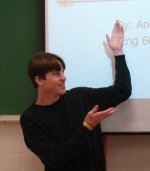

The picture is from the department's picnic in May and not the wedding. The poem is a sijo, a classic Korean form. Here's my own very brief definition.

July 25, 2007

"Say What?"

Andrew JonesDo you feel overwhelmed when you have to do research and presents the results in a written or oral report?
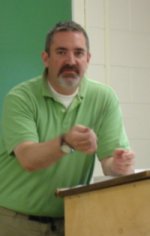
Writing is an essential skill for professionals in almost any field. Speaking to people, in groups large or small, is also an important skill for professionals. Most of our department's writing courses include a presentation, usually toward the end of the semester, on a topic that the student writes about and makes the topic of a presentation. In this year's summer school session, Dr. Kris Swenson's English 60 class explored representations of World War II. In the photograph, Andrew Jones begins his presentation on the importance of the US Air Force in winning that war.

English 60 — Writing and Research — builds on skills the student developed in Freshman Composition to develop substantial reports both written and oral. With networked computers and projectors in each classroom, students have ready access to technology such as PowerPoint to support their presentations. We've come a long way from overhead transparencies and flip charts.

This may be the last summer school entry for this year. Students in writing classes benefit from the concentration of summer school; working each day instead of every other day make for better continuity and focus.

July 22, 2007

"I search, you search, . . . research"

The University of Missouri - Rolla is a technological research university. Does that mean that all research done at UMR is technological? Of course not. One immediately thinks of the sciences here and their vigorous research programs. Are there areas at UMR which don't do research? What about the humanities and the social sciences?

This post will stick with the humanities and, specifically, with the Department of English and Technical Communication. Do members of this department's faculty do research? Yes, of course. And what kind of research do we do? Even though the department has two disciplines — English, especially literary studies, and technical communication — the research techniques are very similar. For both literary studies and technical communication, research istext-based, especially if one defines "text" to include audio, visual, and electronic media.

As does scientific research, our research involves forming hypotheses that are investigated, tested, and applied with research. However, scientific and technical research occurs in very obvious laboratories or in specific sites. Where is research in English and Tech Comm disciplines sited? In libraries, on the Internet, and also in specific locations. We make use not only of traditional printed texts but of texts in other media, of observations and of firsthand explorations such as interviews.

Since we don't have laboratories full of high-tech equipment, some folks assume our research doesn't require much support. But we do need support for our research: funds for library purchases, for travel to specialized libraries (two of us have gone to England for research), for software, for the time needed to explore and complete a research project. Like other researchers, we also require support for travel to professional conferences and gatherings where we share and discuss our research.

It may not seem obvious, but even poets and fiction writers do research. The research done by creative writers needs much the same kind of support as literary or technical communication research.

My purpose in this post is not to discuss the value of research in our disciplines, but I will say that literary research and technical communication research add to our culture's knowledge of human experience and its meanings. Trent Watts' work on images of manhood in the southern USA, Kate Drowne's discussion of the relationship between the social and literary experience of Prohibition in the 1920s, Jack Morgan's account of Thomas Sweeney, the 19th Century Irish-American general, David Wright's investigation of the diffusion of technology in the cattle industry — these examples come from half of the department but indicate the range of our explorations.

July 18, 2007

"And the Winner Is . . . "

Last May, the UMR Writing Center presented awards to the winners of its annual student writing contest. Prizes were awarded in Short Story (General Topic), Short Story (Science Fiction/Fantasy), Analytical Essay, Research, Autobiographical/Personal Essay, Technical Writing, and Freshman Composition, with first, second, and third prizes in each category. This year was the sixth writing contest conducted by the Writing Center.

The majors of students who won awards in the contest range from English to Biochemical Engineering to Geology to Information Science and Technology. This list doesn't include all the majors, but it should dispel the common notion that only English majors can (or will) write. While our English majors do write well, so do students in other majors. And students in majors other than English can excel in writing outside technical or scientific topics. For example, the first place in fiction, general topic, went to Anna Clausen, a junior in Geology and Geophysics.

The Writing Center is part of UMR's Writing Across the Curriculum program. Why am I writing about it here? It's pertinent in this blog because many—not all—of the winning entries were written for classes taught by the English and Technical Communication faculty and because the Writing Center Director, Dr. Kate Drowne, is a member of the English and Technical Communication faculty.

We are proud of all the students, English majors and others, who write so well, of Dr. Drowne, and of the Writing Center and its associated services and programs.

July 15, 2007

Hawthorne and Summer in the Ozarks

trent_in_class.jpeg The photo shows Dr. Trent Watts, Assistant Professor of English and Technical Communication, making a point in his summer school class. In this particular session, the class was discussing Nathaniel Hawthorne's short story, "The Minister's Black Veil."
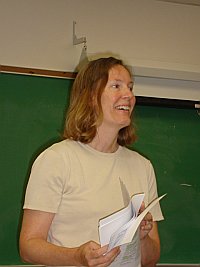
Hawthorne's explorations of Puritan New England might seem like heavy work on a warm July day in the 21st century Ozarks. In fact, the atmosphere in Hawthorne's fiction is often dark enough to chill the summer heat here in Rolla. Dr. Watts is teaching American Literature I this summer, thus the Hawthorne. I asked him to comment on summer school and on early American literature. Here's what he told me:

On Summer Teaching
"In summer school students typically take one or two courses rather than the four or five they take during the fall and spring semesters. This more relaxed pace gives professors and students a chance really to concentrate on classes within the major or to explore a new subject. The classes are typically small and the campus offers few distractions from academic work. "
On Early American Literature
"This literature is timely and relevant because it shows Americans wrestling with the very same questions that animate us today: what does it mean to be an American? how can we make a nation from such diverse peoples? what is the best way to build a government that protects liberties and provides order? what is our connection to and responsibility for the natural world around us?"

Dr. Watts' second comment, of course, includes much more than Hawthorne: just a few of the writers covered are
Henry David Thoreau, Ralph Waldo Emerson, Herman Melville, and Emily Dickinson.

July 11, 2007

Ghazal? Say "guzzle," not "gazelle"

In the last eight years, I have published a webzine devoted to the ghazal as a form for poetry in English. I've been privileged to publish a number of excellent poems by accomplished poets, as well as some informative and provocative prose about the ghazal.

Recently, I've published the July issue and a special issue, both of which are important additions to The Ghazal Page. The July issue has six excellent ghazals, each with its distinct voice. The special issue is an article, "English Ghazals Based on Arabic Forms," which challenges some of the conventional ideas about ghazals in English.

Why do I publish The Ghazal Page? Why am I writing about it here?

As department chair, I have a number of duties and responsibilities. One responsibility is to maintain my research program. During my career, writing poetry has been my primary research. Recently, The Ghazal Page has been my major research project. I believe the ghazal form holds great promise for poetry written in English and want to do my part to make that happen.

UMR seeks to be a diverse community of scholars within a world-wide environment. The ghazal, originating in Arabic and Persian cultures, has potential for widening our understanding of and communication with important areas of the world. The Ghazal Page has published poems from India, South Africa, Uzbekistan, and Singapore (as well as Canada and New Mexico).

Here is some information on the ghazal form. There're also several links on The Ghazal Page. The links take you to other sites that discuss or publish ghazals.

July 08, 2007

What, Me Write?

Given the University of Missouri - Rolla's strong reputation as an engineering school, you might be surprised to discover how many students write fiction, poetry, and personal essays. (They also write reports for technical classes, papers for history, literature, philosophy and other disciplines, and other academic and professional writing.) UMR students have many talents worth exploring.

I was surprised early in my career here to find that students in scientific and technological fields had interests and abilities in the arts and humanities. UMR has long had courses and events in music, art, and theater, in addition to writing and literature courses offered in English and Technical Communication. The student newspaper, The Miner, has been around for a long time. So has UMR's student literary and arts magazine, Southwinds, which is over 35 years old. If one were to tabulate the majors of all the students who've contributed writing and graphic art to Southwinds over the years, one would find a surprising number of engineering and other technical majors represented.

The current issue of Southwinds was published in the spring of 2007. It is one of the best-looking issues, with a full-color cover and a number of b&w photographs. The contributors include current undergraduate and graduate students, faculty and staff, and alumni. Mzx Tohline (English 2007) was editor in chief, and Anne Cotterill (Assoc. Prof. in Englsh) the faculty advisor.

Southwinds 2007 costs $3.00 and is available in the English and Technical Communication office and in the UMR Bookstore. It's well worth the price. Get one and discover a whole different side of UMR.

July 04, 2007

In the Sum- Sum- Summertime

kathy.jpg Technical Writing (English 160) is one of our most offered courses, given every semester and in summer school for decades. Why is this course so consistent in its appeal to students? Because most UMR students know they will need to write reports and do presentations once they have their degrees and are working as professionals.

The photograph shows Dr. Kathryn Northcut as she begins a session of the technical writing course she's teaching this summer. Summer school is its own special thing. I'm writing this entry the day before the 4th of July, one of the events that make summer school so special. Another is the unrelenting pace of classes meeting day-after-day.

The compression and intensity of summer school can provide enjoyment: classes meet from 8:00 until early afternoon. Students and teachers can focus their work more effectively, at least in writing classes, and explore the subject matter in depth in 60 minute sessions that meet five days a week. In the summer, there are about 20% of the students on campus as in the regular semesters. The university sponsors a variety of camps and other events for students K-12, so there is a variety of people and activities that one doesn't usually see in during regular semesters.

The weather—when it's not pouring rain or scorching hot—invites outdoor activities, relaxes students and teachers, invites sitting and talking, reading in the shade, perhaps even snoozing in a quiet place. None of these pleasures, though, negates the daily flow of classes, assignments, or reports due. When class is finished for the day, one has a sense of space, of openness, freedom . . . until one (whether teacher or student) remembers the next day's assignment.

July 03, 2007

How Many Ideas Can I Have?

When I started this blog two weeks ago, I planned to do three entries a week. I had been thinking about some ideas for entries for awhile. I did post three times each of the first two weeks. However, I'm going to reduce the number of entries to two a week, on Wednesday and Sunday, scheduled to post at noon. Rather than posting "whenever," I want the entries to be predictable.

It doesn't take a long time to do an entry, but it does take time, so two a week will work better than three. Also, I may not have ideas for three entries every week.

The first Wednesday entry should post on July 4th. Hope you check it out.

July 01, 2007

Lessons for the Chair

Those who've known me for awhile may be surprised that I'm department chair. I'm as surprised as anyone. I said more than once that I never wanted to be chair. But now I am and have been for 18 months.

How am I finding it? Different than I had thought. Not as hard in some ways, harder in others. Truth to tell, I find rewards and satisfactions as chair. (Frustrations and perplexities too, of course.) I have learned a lot of how things work: things like managing the budget, scheduling courses, working with development, hiring faculty, recruiting students, and much else. Many of those procedures are changing under the new system, which takes effect today, 1 July 2007.

But this entry is not about the daily details of managing the department or the new organization of the campus. It is about some basic lessons I'm learning as chair.

Here's a brief list of some important lessons. Most people probably already know them. I would've acknowledged them back in the pre-chair past. They are much different from my current perspective.


  1. It's never done. I'll never finish everything. I may complete—I'd better!—this task or that, but there will always be more to do, an indefinite queue of "doables." When I am chair no longer, there will still be things undone. Can't be avoided.

    Knowing that everything will never be done—that I can never sit back at 4:30 and say, "Nothing else to do; see what comes in tomorrow," that knowledge is a relief. I can do what is immediate, then what is intermediate, and then, maybe, the distant. I'll always have something to do tomorrow.


  2. I'm not alone. It's heartening to find that I'm not the only chair who feels he/she doesn't know everything and seeks to find the right procedure and the right information. My fellow chairs are more knowledgeable and competent than I, and I learn from them. I also find their uncertainties reassuring in the face of my own. If I don't know everything, that's okay.

And? I'm finding that I can do the job and find satisfaction in it. The department I chair is a good department: talented teachers, productive researchers, involved students. I can't take credit for their achievements, but I can help them achieve.