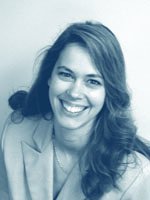
 A primary question of prospective students is, "What can I do with a degree in English?" Here is one example of sort of thing graduates of our programs do when they graduate.
Rebecca Frisbee joined the University of Missouri – Rolla’s Publications Relations Office in 1992 after graduating with a BA in English in 1990. Rebecca has been with Publications Relations for 15 years. In 1995, Rebecca became manager of the department, and art and production editor for the MSM-UMR Magazine. In 2005, she led the redesign efforts of the alumni magazine when we changed its name to UMR Magazine.
Rebecca will begin her new duties as manager of marketing for the School of Extended Learning on Oct. 1. It covers Distance and Continuing Education, International Affairs, and the Engineering Education Center in St. Louis. On behalf of the Department of English and Technical Communication — Congratulations, Rebecca!
Archives for September 2007
Promotion for Rebecca Frisbee
New and Better Computing
The English Department began developing ideas for a writing center in the 1990s. Dr. Elizabeth Cummins and Dr. Larry Vonalt were important forces behind the department’s request for a Center for Writing Technologies. Their project was finally realized in the establishment of the Writing Across the Curriculum Program, which includes the Dr. Beverley Moeller Writing Studio and the Center for Writing Technologies.
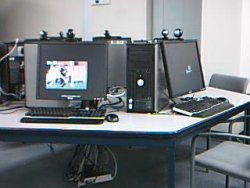
A pod of new computers in the Writing Center
Photo taken with the webcam on one of the new computers
While administratively separate from the Department of English and Technical Communication, the Writing Center and the department are close allies, especially concerning the Center for Writing Technologies (usually called "The Writing Center").
This summer, the department arrived at a plan to share licensing fees for new and upgraded hardware and software. I’m sure you are aware of the rate of change of software and hardware. To best serve our students, especially majors in Technical Communication, we need the best equipment and software available. The Writing Center was updated this August.
The updates this summer make the Writing Center UMR’s premier authoring lab. It was designed by a committee of faculty and staff from various departments: Todd Kreuger (Information Technology [IT]), Connie Melone (IT), Jim Turner (IT), John Sequin (Library), Kate Drowne (English and Technical Communication), Richard Hall (Information Science & Technology), and Ed Malone (English and Technical Communication). The new equipment and software were paid for by IT, Center for Technology Enhanced Learning, and English and Technical Communication
In the future, this lab will accommodate such courses as Web-Based Communication and Multimedia Development and Design. In TCH COM classes this semester, students are authoring help systems with RoboHelp and creating books with FrameMaker; next semester, they will be conducting usability tests and creating tutorials with Camtasia.
The lab has extended hours this semester (6-9 M-Th and 12-9 on Sundays) and hired a lab monitor to help patrons.
The new and updated software is available in two other locations on campus. In Computer Science 207, all of the Adobe programs — except RoboHelp — are available 24/7. One of the machines in the library also has all of the Adobe programs — including RoboHelp — so that a student can complete assignments on Friday evenings or
Saturdays. The library also purchased a collection of Adobe classroom-in-a-book tutorials for the specific versions of Adobe programs we have and other tutorials for RoboHelp, Camtasia, and so on.
Online Scholarship
One consequence of the increasing use of the World Wide Web is the migration of scholarship to online venues. Internet publication has many advantages for scholarly and creative work, especially ease of access for millions of people.
Dr Elizabeth Cummins, Professor Emeritus of English and Technical Communication, is one of the scholars whose work is being published online. Her Judith Merrill: A Primary and Secondary Bibliography has just been published by the Center for the Bibliography of Science Fiction and Fantasy at Texas A&M University.
The site’s Introduction explains the background: the loss of print publishers for scholarly bibliographies and yet the continuing need scholars have for such bibliographies. Sponsored "by the Science Fiction Research Association, The International Association for the Fantastic in the Arts, Extrapolation magazine, and the Science Fiction and Fantasy Research Collection, Cushing Library, Texas A&M University," the Center is a fully qualified scholarly publisher
Earlier in the history of publication on the World Wide Web, many questioned whether such publication really counts as "scholarly," as legitimate publication, or as a kind of vanity publishing. Like other Web publishers, the Center for the Bibliography of Science Fiction and Fantasy qualifies as a full-fledged scholarly publisher. The bibliographies it publishes are reviewed by a qualified editorial board just as they would be for hard copy publishers.
Congratulations to Dr. Cummins on the latest publication of a labor of scholarly love. Judith Merrill is a crucial editor and writer in SF; now scholars around the world have ready access to this outstanding bibliography.
New Roles for Two Faculty Members
Beginning with the fall 2007 semester, Dr. Kris Swenson and Dr. Ed Malone, will each add a new role to their responsibilities in the Department of English and Technical Communication. As the number of students increases, managing the courses they take becomes more complex. The department itself is changing in response to changes in the student body and to changes in the campus. In addition, our BS and MS degrees in Technical Communication are not quite two years old: these programs need attention and effort to develop most effectively.
As Coordinator of Writing Courses, Dr. Swenson will oversee the Department’s English 20 (Exposition and Argumentation) and English 60 (Writing and Research). English 20 is "freshman comp," an important course taken by almost all incoming freshman. Her duties also include working with the faculty teaching these courses and coordinating policies and practices for the courses.
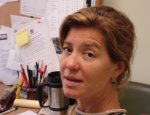
Dr. Kris Swenson
As Director of Technical Communication, Dr. Malone will work extensively with the graduate students on issues ranging from admission to keeping statistics on their test scores. Dr. Malone will also aid in recruiting both undergraduate and graduate students for the technical communication programs.
Dr. Ed Malone
For my part as chair, I welcome these new roles for Dr. Swenson and Dr. Malone. The department will function more effectively because of their contributions. Thanks are due the Provost, Dr. W. Kent Wray, and the Chancellor, Dr. Jack Carney, for making these new roles possible.
Celebration
The fall semester has well and truly begun. The first wave of student questions and dilemmas is over. (That first wave ranges from trying to find a classroom to trying to get into a class to finding an instructor.) For all that the university has over 1200 new freshman, there were fewer problems of this kind this fall.
Now that enrollment and class schedules have pretty well settled down, faculty, students, and staff can take stock and focus fully on the tasks of teaching, learning, and facilitating. The Department of English and Technical Communication sponsored a "Welcome Back" reception on Tuesday, August 28. Students and faculty from several departments mingled and ate goodies. 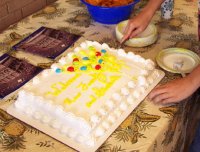 In this photo, Erin Cotita, English major and department student assistant, prepares to cut the cake for serving.
The reception ran from 1:00 to 2:30; those attending did more than eat, as shown in this photo of students (Irangi, Li and Tommy) talking with Professor Emeritus, Nick Knight, and parent, Glenn Cotita. 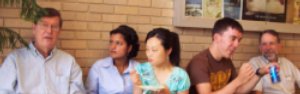
Together with the break in the heat we’re experiencing (highs of 85 F are much more pleasant than highs of 105 F) and the relatively smooth start of a new semester, this reception put, so to speak, the icing on the cake. (Or the dip on the crudités. if you will.)